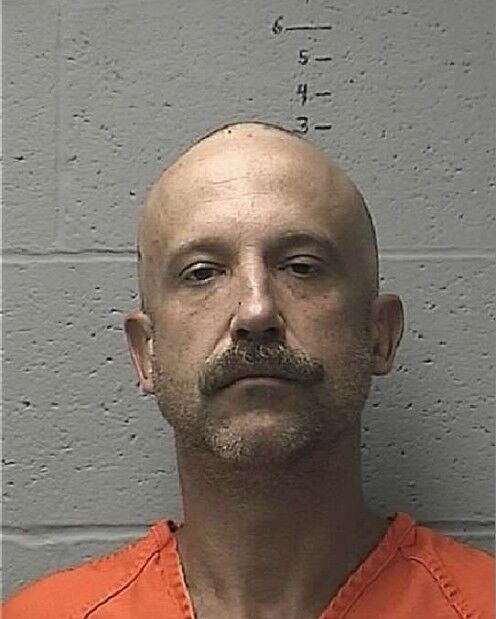
Judge sentences Wright to life without parole
STE. GENEVIEVE – If for some reason the Court of Appeals would overturn Ronald Wright’s life sentence on his murder charge, Wright still has a 200-year-sentence and a life sentence to serve.
On Tuesday, Circuit Court Judge Kenneth W. Pratte sentenced Ronald Wright, 48, of Farmington, to life without the possibility of parole on the first-degree murder charge; 200 years in prison on the armed criminal action charge; and life on the burglary charge. In 2008, Wright murdered John E. Shaw, a 77-year-old Ste. Genevieve County man who was a Korean War veteran.
After announcing the sentence, Judge Pratte said this murder was a savage and senseless destruction of life. He said John Shaw was a decent man who didn’t deserve anything like what he received from Wright, who was a total stranger.
“You viciously beat that man to death with a hammer,” Judge Pratte said.
Jean Shaw, John’s husband, wrote a letter to the judge which Ste. Genevieve County Prosecuting Attorney Carl Kinsky read aloud Tuesday. She said it was a brutal, senseless murder that haunts her memories and brings her mental anguish way too often.
She said her 77-year-old husband was loved by all his family and was a good, humorous, Christian man who served this country in the Korean War and was a POW.
Jean Shaw asked the judge to ignore any requests Wright may have for leniency. She said Wright would be a danger to society if he were ever released or paroled.
She pointed out it could have been a double murder if Wright would have been successful in luring her out of hiding.
Life without the possibility of parole was the only sentence Wright could have received Wednesday for the first-degree murder charge.
Kinsky said he was asking for the additional 200 years and life, for two reasons.
He said the first reason was in case the first-degree murder charge/conviction would be reversed on appeal.
Wright, who had been a chronic meth user, intends to file an appeal with one argument being that he was suffering from a meth-induced psychosis at the time of the murder which caused a diminished mental capacity comparable to paranoid schizophrenia.
Kinsky said the state and common law has rejected the argument that drug-induced psychosis is a mental disease or defect because it occurs due to voluntary ingestion with the person knowing it will cause impaired judgment.
Kinsky said his second reason for recommending such a long sentence is because the crime is especially outrageous and the sentence should express society’s feelings about the defendant’s conduct. He said John Shaw did absolutely nothing to ask for this cruelty. John Shaw didn’t even know Wright.
He pointed out to Judge Pratte that this good husband, father and citizen didn’t help Wright by yelling his wife’s name when Wright was trying to lure Jean Shaw back into the house.
Kinsky said if Wright hadn’t been caught for breaking into someone’s garage hours later, there could have been multiple murders.
Wright’s public defender, District Defender Wayne Williams, had asked the judge to consider a three-year sentence for armed criminal action and a five-year sentence for burglary. He asked that these run concurrent or along with the sentence for murder.
His argument was that Wright will already have the life sentence without the possibility of parole for the murder charge.
Williams reminded the judge that Wright was suffering from auditory hallucinations at the time of the murder. At trial, Wright had said the voices, and “signs” such as an American flag and a license plate with letters that formed something similar to the Muslim word for God led him to John Shaw’s home. He testified he thought these people were terrorists who had a killing kit.
Williams said Wright’s long criminal history is primarily drug-related. Williams also reminded the judge that Wright has shown remorse throughout the case.
When granted permission to speak, Wright turned around to face the audience. He said he was very sorry to John Shaw and his family, as well as his own family and the shame he has brought on them. He said he wasn’t asking for forgiveness.
Wright said he wasn’t thinking right. “I’m not saying I wasn’t to blame …” he said. At trial, Wright admitted he beat the man to death.
Wright, who appeared to be crying, recited a poem from memory which he said he wrote a year and a half ago. In the poem, he talks about people watching him and trying to hurt his family. He said he did a terrible thing when he wanted to help people. He asked for God’s forgiveness so he won’t be sent to hell.
When questioned about his attorney, Wright said he didn’t have enough time to talk to his attorney before trial and he was not satisfied with Williams’ service as attorney.
During the two-day trial in May, Ste. Genevieve County jurors heard testimony from 21 witnesses for the prosecution. Wright testified on his own behalf and his mother offered testimony which was very brief due to the state’s objections.
Wright’s previous felony convictions over the years included sale of marijuana, two counts of possession of a controlled substance, possession of drug paraphernalia with intent to use, felon in possession of a firearm, failure to pay child support and driving while intoxicated.
At the time he killed John Shaw, Wright was on probation and parole. In fact, his probation officer had directed Wright to come to the probation and parole office at 1 p.m. the day of the murder. Wright did not show.
The murder occurred at the Shaw’s home off of Route D in southern Ste. Genevieve County near St. Francois County on October 16, 2008. John Shaw died of blunt force trauma and police allege Wright beat him to death with a sledgehammer.
According to police reports, Jean Shaw called 911 that afternoon after a man came to her house on Collin Court Drive and reportedly began assaulting her husband. She got out of the home and hid in a weeded area until police arrived.
When police arrived, they found John Shaw dead.
Police questioned two other people before they learned Wright had been arrested in St. Francois County later that same day and in close proximity for another reported home invasion.
Lt. Lance White said by then he had also received a description from a neighbor of a man seen at the Shaw residence before the murder.
White and Sgt. Dave Bauer of the highway patrol interviewed Wright two days after the murder, but Wright did not make any incriminating statements about the murder.
Three days later, after getting results from the Missouri State Highway Patrol crime lab, the two officers went back and interviewed Wright. White said the report showed a fingerprint at the scene matched Wright’s.
White said Wright confessed. Wright told him that voices in his head told him to go to Shaw’s house.
Teresa Ressel is a reporter for the Daily Journal and can be reached at 573-431-2010, ext. 179 or at tressel@dailyjournalonline.com.