
Park Hills hosts town hall meeting to address Reworld concerns

Representatives from the City of Park Hills hear comments from the public. Lisa Brotherton-Barnes
The Park Hills City Council adjusted their regular monthly meeting to be held at Mineral Area College’s Cardinal Center on March 11. They hosted representatives from Reworld and KimHEC, allowing residents and community members to learn about the proposed facility at the former glass factory location. An announced question and answer session with the visitors drew a sizable attendance.
In response to social media concerns about the incoming MPF at the former glass factory, the City of Park Hills issued a public statement dated Feb. 5. It summarized the three primary concerns being expressed either in social media discussions or directly to city representatives and responded to each categorical concern based on information supplied by Reworld.
- Concern about hazardous and/or biomedical wastes: This facility will not process hazardous and/or biomedical wastes. The materials handled at this facility will be strictly non-hazardous.
- Concern about “incineration”: There seems to be a misunderstanding that this facility will function as an “incinerator.” We want to assure you that this is not the case. This facility will only act as a processing and transfer operation with NO “incineration” processes; Reworld has stated that no operations at the facility result in any air pollution control requirements.
- Concern about water contamination: We understand the importance of clean water and want to assure you that Reworld will implement all necessary measures to ensure no water contamination occurs. It included information regarding environmental safeguards, job opportunities, which parties have regulatory oversight responsibilities, wastewater management, and measures the city is implementing to protect the community. Key points were that no hazardous or biomedical waste will be processed, no incineration will take place at this facility, strict environmental controls will be implemented, and the facility will create 21 new jobs.
The City of Park Hills released a Frequently Asked Questions document on Feb. 11 that shared Reworld’s operating plans for the facility.
“We are developing a state-of-the-art multifaceted materials processing and transfer facility (MPF). The facility will process and transfer non-hazardous waste and recovered materials from industry and commercial facilities, including local businesses, converting them into usable products or materials or preparing them for recycling, energy recovery, or final off-site disposal. In addition, we are planning to install a state-of-the-art wastewater pretreatment system. This system will use various treatment steps, including neutralization and flocculation, to prepare non-hazardous industrial waters so they can be safely sent to the local wastewater treatment plant for final treatment.”
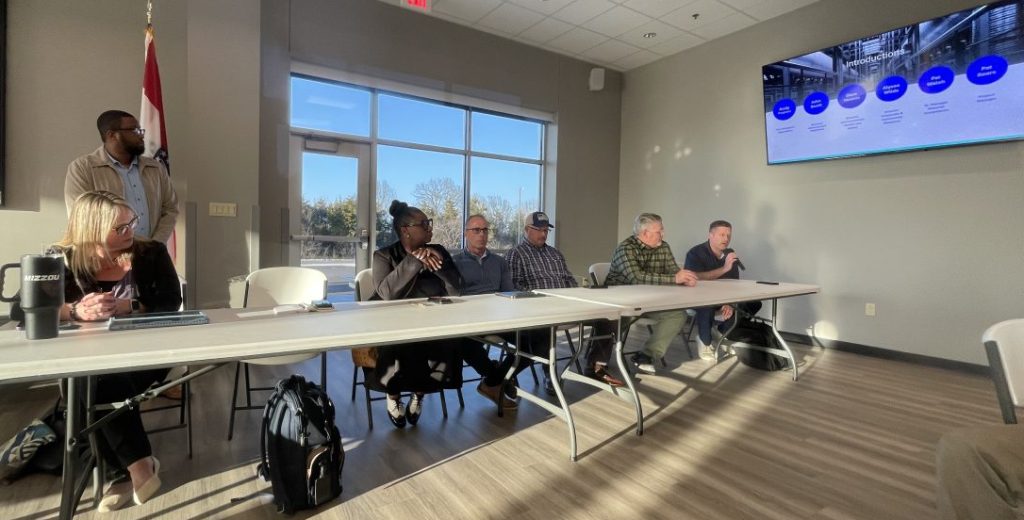
Representatives from KimHEC and Reworld Solutions participate in a question and answer session with meeting attendees. Lisa Brotherton-Barnes
Three patented processes had been planned at the facility:
- Creating a coal substitute from recovered materials (ReKiln™)
- Industrial water treatment (ReDrop™) [It is important to note that this part of the operations is no longer in the plan. It is currently unknown whether it is permanently removed from the plan or delayed until some undetermined future date. Reworld chose not to proceed with the wastewater operation based on the capacity limitations offered by the city, which was capacity based on forecasted growth.]
- Non-hazardous material and waste processing (ReDirect360™)
Concerns mounted and the city determined that the next best course of action to lay fears to rest would be a town hall meeting so detailed information could be shared with the community by stakeholders who are immediately involved in the project.
The agenda was very streamlined, but the meeting lasted nearly three hours, allowing the large number of attendees to fully participate in public comment time. At the top of the meeting, Mayor Stacey Easter explained the order of events. She said that after the presentation from the members of the guest panel, attendees could approach the podium and microphone to state their names and addresses for the meeting record, and they would be given five minutes to address the council or guests and receive a response. All comments were requested to be specific to the proposed Reworld operation in Park Hills. After all, the initial speakers had an opportunity to make their comments, and if time permitted, they could return for additional comments.
Environmental consultant KimHEC
Kim Cole, owner and founder of St. Louis-based KimHEC (Humans and Environment Connected) Environmental Consulting, introduced herself as a provider of specialized water treatment consultation services to equip clients with guidance regarding environmental sustainability. She opened the discussion with an overview of her company, the base of clients it serves, the scope of its consulting expertise, and the beginning of her working relationship with the City of Park Hills.
“I’ve been working with the City of Park Hills for several months,” she said. “I work for more than 25 communities here in Missouri and a few other states here in the Midwest. My work is focused chiefly on wastewater and regulating industrial discharges. Most of my clients are municipalities that have industrial discharges. In a given year, we do more than 100 industrial user inspections. We do a lot of industries, and I see a lot of different operations with a lot of different wastewater discharges. That’s the kind of experience I bring to the table for the City of Park Hills.
“The scope has expanded from originally when I was contracted; it was just wastewater. Now, it’s expanded into other environmental media due to other operations that Reworld is performing. In my undergrad, I worked at a refinery in Texas, where there are all kinds of environmental media, from cleanups to air pollution to hazardous waste. I’ve worked at a Department of Energy remediation site in Bernal, Ohio. So I have an interesting background that prepares me to help the City of Park Hills.”
Cole said she likes to think that her job is to ask questions so she understands the operating parameters. That is the role she is filling for the City of Park Hills, working alongside City Administrator Franklin and Utilities Director Henderson. She emphasized an important point in the plan to move forward.
“I want to point out that they [officials from the City of Park Hills] approached me before there was an issue. Before this conversation came up [for the town hall meeting], they reached out to ask me to look at their city code and make sure the city is prepared [with relevant ordinances in place] to have this new industry [Reworld Solutions’ proposed materials processing facility] coming into town,” Cole said. “We need economic development. We need to be able to function in a way where industries can operate in a way that doesn’t negatively impact the environment. That’s the heart of what I do, and I believe in data-driven solutions.”.
A slide distinguished operations requiring air permits from those without requirements. Operations requiring an air permit listed glass factories [like the one that had previously operated at the property], asphalt plants, concrete batch plants, automobile assembly, rendering plants, woodworking operations, and any operation that includes combustion; these are not operations that will be conducted at Park Hills. Operations not requiring an air permit listed grinding, drying, and bringing materials on site that are not known to be odorous; these are the operations that will be conducted in Park Hills.
Cole said, “We’ve been talking to Reworld about what type of capacity the city’s wastewater plant has, and they’ve recently decided that the city’s capacity isn’t adequate for them to consider it a viable operation. I updated [the slide] to say that those operations are probably delayed until the city has more capacity based on the numbers we are looking at. When discussing air, solid waste, hazardous waste, and stormwater, Missouri DNR has the authority to issue those permits.
“The city generally does not have the local ability to regulate and issue permits for those types of operations. There are things that the city could do proactively. Communities with populations of over 10,000 are required to have an MS4 community, where you have to have a code to address stormwater concerns. The city does not meet the trigger for the state to require a program for stormwater. You can proactively have a stormwater code without meeting that minimum requirement and those are some of the conversations that I’ve been having with Zach [Franklin] and Jeremy [Henderson]. Regarding solid waste, the state has jurisdiction to issue those permits, Reworld submitted their application [near the end of 2024] and the state has [up to] a year to decide what to do with that application. Reworld is not proposing anything to do with hazardous waste or hazardous materials.”
Reworld guest introductions

The scales are ready to receive and weigh incoming materials for processing at the MPF on Taylor Avenue. Lisa Brotherton-Barnes
John Scott, Director of Government Relations, introduced himself and said, “We plan on educating you about the facility, about what we do, and ultimately who we are as Reworld, but also inside of our operations. At the end of that, we will have Q&A. We look forward to answering questions regarding the facility and its operations.”
Alyssa Wilds, Director of Corporate and Community Relations, introduced herself and said she had been with Reworld for almost four years and is responsible for community outreach nationwide. Dominic Valencia, Director of Environmental Health and Safety, has been with the company for about 18 years and expressed his appreciation to the attendees for coming to the meeting.
Pat Sears introduced himself as a Project Manager under a consulting and contract agreement. He said, “I have spent the last 36 years of my life in the recycling business, owning and operating various facilities throughout the United States. I’m glad to work with the Reworld folks here in Park Hills, and I’ve enjoyed my last four months getting to know you guys.”
Andy Ferguson, Vice President of Operations, said he had been with the company for ten years when it was operating under the name Covanta, and it purchased his company. “I’ve been in the industry about 30 years, 35 years like Pat, but I’ve always been in the environmental space doing the type of work we will do here at Reworld’s MPF in Park Hills.”
Pat Walsh, Senior Manager of Material Approvals and Compliance, has been with the company for about 29 years. “ I know that part of the business very well, as it involves the operations and how we stay compliant to be safe.
Reworld operations overview
John Scott then provided a broad overview of Reworld. He said the company has more than 90 facilities in the United States and more than 4,500 employees, and that number is growing. He emphasized their focus on community engagement and that they have accumulated over 12,000 volunteer hours across their fleet with engaged and active employees.
“From a sustainability standpoint, we have recovered over 500,000 tons of metal, recycled over 280 million gallons of wastewater, and have generated more than 10 million megahertz of electricity from the waste that we sustainably manage. Park Hills will be a materials processing facility (MPF), so we’ll talk about what that facility does versus some of our other facilities,” he said.
Dominic Valencia picked up the conversation to emphasize the Park Hills facility’s designation as an MPF rather than a thermal mechanical treatment facility (TTF), which had been an early concern from community advocates who had learned of negative environmental and health situations created by other facilities where combustion and incineration were part of the processing.
“I think there’s a major misconception out in the community about what our facility is in Park Hills versus some of the other facilities that we have in the fleet,” he said, providing a visual aid depicting two operational models Reworld utilizes, the TTP and MPF. “They are drastically different styles and types of facilities. I think that is something that we need to put out there for the community to understand. The Park Hills facility will not combust or burn any materials entering that facility. I think that’s important, and I’ll say that again: the facility in Park Hills will not burn or combust any materials that are coming into that facility. I think another thing to be cognizant of is everything that comes into this facility will go out of the facility, which will be from a reuse, recycle, and use standpoint.
“We do not accept hazardous waste at this facility. We do not accept biomedical waste at this facility. This facility is strictly a commercial, industrial processing disbarred material facility, and we’ll get into what that looks like further down the line in the presentation. Another thing to mention is the way that facility looks from the outside is how it will look when we’re in operation. There are absolutely no activities that will be taking place outdoors at this facility.
Reworld community benefits
Alyssa Wilds highlighted community benefits through their hiring practices.
She said, “Reworld is very committed to hiring locally. We partner with local colleges and universities to create workforce development pipelines. We want to ensure that your community’s residents have the skills needed to work in our facilities. We offer above-average compensation as well as a competitive benefits package. We make sure that we do everything we can to make sure that the residents in our host cities, not just surrounding areas, but making sure that the residents in our cities are being hired. We also work with vocational and technical schools because not every job in our facilities will need a degree. Some of them will come right out of high school. We have partnered with high schools and other communities for students who come out with boiler licenses and electrical equipment straight out of high school and won’t go to college. They can come right into our facility.
“We have competitive wages and benefits packages, and we are hiring directly from our communities all around the country. We also hire local contractors. We have already engaged about 11 contractors, and we’re currently working with Lee Mechanical and Goheen Electric. We are making sure that not only are we hiring locals for the inside of our facility, but we are hiring your contractors. We’ve already invested about $6 million into that facility, and we continue to give back to the state and the local area with all we do. As soon as we’re fully up and running, we will make sure that we go to career fairs and other things to ensure we keep the information out in the community. So we’re doing all of the things to make sure that you guys get the benefits of Reworld being in your community.”
Materials processing overview
Materials processing was explained using a short video. After the commercial team sources the material, it arrives at the facility by trucks with enclosed trailers, where quality assurance and control samples are taken to ensure the material matches the description provided by the customer. If it passes the sampling stage, the material is offloaded and staged for processing. The materials go through shredders, conveyors, and magnets for sizing and metal removal. Liquid materials are tested for compatibility before mixing to ensure breathable hazards are not created. Liquids are then mixed with an inert additive filler to transform them into semi-solids, making them convenient to transport out of the facility.
The processed material is then sent to TTFs to generate energy (steam or electricity) or to local cement kilns as a replacement for coal. A strict quality control process ensures that the materials meet certain specifications before they can be used in those facilities. If the materials fail to meet the standards, they are either rejected and returned to the facility that generated them or forwarded to a different facility.
Special emphasis was placed on the qualification processes involving the material before it arrives at the facility. It was explained that the customer provides a materials profile form with information about the waste composition, chemistry, and packaging. Material profile specialists review the form for compliance and safety. If approved, the customer receives a specific approval with an approval number, which is required for shipment. Once the material arrives, it is inspected, and samples are tested to verify compliance with the profile and permits.
Items that will not be approved include municipal solid waste (residential curbside garbage), EPA-defined hazardous items and flammable corrosives, and biomedical waste. The facility will only accept recovered materials for cement kiln use after they pass the profiling and specialist review stages.
John Scott closed the information session with a few remarks, “I wanted to talk in closing about our commitment to Park Hills: we run a safe and compliant operation, and we want to make sure you know that. We want to make sure that everybody understands that we’re ready and do communicate–transparent, two-way communication. Ultimately, we want to be an employment partner, and we want to be the employer of choice in the town. Our expectation and our ask of ourselves is to be a good community partner.”
Q&A session

During public comment time, attendees addressed their comments and concerns to representatives from the City of Park Hills and the guests from KimHEC and Reworld. Lisa Brotherton-Barnes
Approximately 24 attendees took advantage of public comment time. Concerns expressed covered a wide range of topics: the negative impact the facility could have on their property values, the burden the operations would place on their struggling water and wastewater infrastructure, the undesirable proximity of the facility to residential neighborhoods and schools, creation of health dangers, noise pollution generation, and the potential for soil and water pollution generated by combustion processes or incineration.
The first speaker said, “We as a community should have been able to present our concerns to the city before this meeting. I oppose the proposed facility directly bordering my backyard. I’m concerned about the impact on my children and community.”
They said they had researched Reworld facilities in other cities; they had compiled a lengthy list of code violations, potential risks, and ethical considerations identified at those locations and were the subject of litigation and penalty assessments. A specific concern for the speaker was that “even though Reworld claims they use non-hazardous materials, the legal definition of ‘hazard’ may not reflect the actual dangers, and industrial wastes labeled as non-hazardous can still contain toxic constituents that pollute the air and water.” A Tulsa, OK facility was cited as an example where they said the contract revealed the facility would handle 60% “special wastes” that included septic tank pumping, dead animals, hatchery waste, tires, and asbestos. “These materials, though categorized as non-hazardous, can still release dangerous substances,” the person said.
The same speaker said, “Because Reworld will process waste in Park Hills to be burned in other communities, there is an ethical obligation to care about the well-being and health of the children in those communities.” The speaker also mentioned fire risks, saying that the cement kiln industry is known for burning waste and the kiln in Festus is 40 miles from Park Hills. They noted a history of uncontrolled fires at waste piles and processing lines at Covanta’s incinerators and other waste facilities made them very concerned, adding that in 2017, Covanta admitted to processing tire-derived fuels and tires, which can cause toxic smoke and are difficult to extinguish when set on fire.
The next person at a Buckley Street address with a line-of-sight view of the plant asked what residents would see from their homes once the facility is operational, sharing their past experiences with the glass factory’s steam and odors in the air. John Scott responded that residents shouldn’t see much difference. There will be vehicular traffic (trucks) but no stack, steam, or odors. The equipment is not loud. Based on deliveries, operations are typically from 7 a.m. to 5 or 6 p.m., and the facility will operate five or six days weekly.
The commenter said Park Hills lost residential recycling services about four years ago and asked if Reworld would consider working with the city to bring them back. John Scott said that while the current facility would not handle recycling residential materials, it would be willing to partner with the city council to help rebuild and guide recycling practices.
A different Buckley Street resident asked about the facility’s daily capacity in tons or trucks and potential future plant expansion. The answer was they anticipate processing approximately 35,000 tons annually when fully operational. About five trucks are expected to enter and exit the facility daily via Taylor Street, making a right turn at the stop sign and crossing the railroad tracks. Incoming materials are primarily transported in enclosed freight trucks, and outgoing materials are shipped in fully tarped and covered walk-in-floors. It was explained that currently, the company only needs 150,000 square feet of the building. Expansion depends on market conditions and working with Phoenix Investors (the property owner).
A commenter asked if the city would accept “undeniable evidence of the company’s repeated betrayals in other communities” and “the city’s plan to address violations of permit conditions by Covanta ReWorld.” Cole said the new legal authority is being developed to give the city more control over regulating pollutants, including unregulated and emerging contaminants. An enforcement response plan is being drafted, focusing on wastewater but also considering stormwater and source water protection. While Cole provided the answer, another attendee distributed a small packet of news briefs and information relating to Reworld’s environmental violations in existing cities.
The commenter’s final points regarded the status of the wastewater system and asked for clarification. Kim Cole explained that the city’s wastewater plant’s forecasted growth did not meet the needs capacity of Reworld, so they decided not to proceed with the wastewater operations plan. She said proper terminology is that Reworld’s water treatment plans and use of the city’s wastewater system are delayed, not permanently removed from the picture.
The following two commenters shared their concerns about the overall water quality in the area (including rivers and streams) and the city’s infrastructure. One commenter said Park Hills’ stormwater dumps into the wastewater system, which causes a city main on her property to stink and overflow during heavy rain, sometimes leaving toilet paper (and other items flushed down toilets) in her parking lot. They asked if the water used to clean the plant’s shelves, conveyor belts, and floors would go into the city’s wastewater collection.
Mayor Easter responded and said that wastewater and water engineering reports had been completed for Park Hills a year and a half ago, adding that the existing system is 70 to 80 years old and has never been replaced, only patched over the years. The administration is working to fund those projects. Work has been done on the water treatment plant and water lines.
John Scott added that only standard restroom wastewater (toilets) will go down the drains. The small lab inside the facility will contain and manage all waste, with no hose bibs for washdown or mopping. Floor cleaning water will be containerized and hauled off-site. Kim Cole added, “The city can issue zero discharge permits, requiring monthly certification that no processed wastewater, including mop water, was discharged.”
City Administrator Zach Franklin said, “From a zoning land use perspective, it meets the qualifications. However, as mentioned earlier, we [the City of Park Hills] are not the regulatory agency. We’re taking further action to ensure compliance, but Missouri DNR is the regulatory agency, so they would issue the permit. So, to answer your question [“Is this a done deal?”], as of today, no. Missouri DNR has 12 months to approve a solid waste permit by state statute. That application was submitted on November 4, 2024, so they would have until November 4, 2025, to review and approve or deny that permit.”
City Attorney Nath Bollinger answered a question by explaining the city’s role and level of authority in the situation: “The city has no authority other than what’s in the ordinance. It’s in the new statutes. So the city can’t come in and say, ‘You know what, we don’t like them. We’ll take this property and do whatever we want with it.’ The city does not have unlimited control of the property; the city does not own it. So the private property owner of it [Phoenix Investors], they have a constitutional right, to contract for the property, to do with what they want, as long as they follow ordinances in the state regulation. The city is making sure they go through the state. The state regulates and approves the permits. The city cannot deny their permits if they apply to DNR or anything that goes to the EPA. The city doesn’t have that authority. What the city has the authority to do is to make sure they follow current city ordinances, which they have looked into [by KimHEC].
He explained that the city has a responsibility to the citizens to ensure everything falls into proper zoning and make new ordinances with greater detail if needed. He said that fell in the arena of the hired consultants, who explored existing ordinances and suggested new ordinances as needed to allow the city more control and ensure compliance.
He concluded his answer by saying,“But as far as the board–there’s no vote. They don’t have the authority to go to a private property owner and say, we’re taking your property from you. It’d be no different than coming to a private individual and saying where you can live and where you cannot. So they are taking steps that are in their power to look into updating the ordinances, and that’s what they have authority to do.”
A resident from Desloge raised concerns about dust generated from the shredding process and its potential impact on air quality, especially given the prevailing winds. Reworld representatives stated they mitigate dust by using high-moisture products or applying misting sprays. They asserted that materials causing significant dusting would not be accepted and that their MPF (Material Processing Facility) does not even require dust masks or special PPE for workers. That in itself is an indicator that the types of materials processed are not high-level dust generators when they are shredded.
A resident questioned how Reworld processes liquid materials like oil, coolant residues, used oil, grease absorbents, printing ink, and paint manufacturing waste. Liquid materials are processed using shredders and decanted into one of three concrete and steel-lined pits or vaults, which occupy about 60 feet of floor space. The liquids are absorbed by inert materials added to the pit, where an excavator is used to mix the materials, resulting in a solid or semi-solid product rather than breaking down the chemical components. A resident inquired about the ordinances in place and the possibility of surprise inspections. They were told there are plans to create and update ordinances to protect the community, potentially with assistance from the Missouri Public Utility Alliance (MPUA). Legal authority grants access to a site for inspections, and the city code holds significance for city, state, and EPA officials.
The facility must obtain a solid waste permit issued by the Missouri DNR, which will provide oversight and dictate how the facility operates. The DNR can inspect the facility at any time. Another resident wanted to know who was the reporting authority for issues after operations were started. They were told that Alyssa Wilds would be the community liaison to address community complaints and concerns. She will work with the mayor’s office to facilitate communication and address concerns effectively. The Reworld website will have a dedicated link for Park Hills.
A local business owner praised Reworld as “a very clean and beneficial facility,” highlighting the importance of job creation and the generation of tax revenue for the city. They noted that the facility’s operations could promote the improvement of the city’s sewer facilities through increased tax revenue, emphasizing that the materials processed are used to lower carbon emissions at other facilities.
An electrician from the Ardall Group expressed support for the associated benefits of a large, financially solvent company coming to a small town, citing good job opportunities and strict environmental regulations at industrial sites.
A resident and chemist expressed support for the facility, emphasizing the need for economic development and community improvement. It was noted that the company is working to mitigate problems left behind by the glass factory operations, removing hazardous materials Primal abandoned, and cleaning the property in general. They also expressed concerns that vacant buildings eventually invite crime, vandalism, and sometimes homeless encampments, often exacerbating crime and vandalism. They reminded those present that the proposed operations do not have documentation of negative aspects and legal battles that many Reworld facilities have.
Learn more
Visit reworldwaste.com to learn more about Reworld as a corporation and explore its processing technologies for sustainability and energy recovery. Visit parkhillsmo.net to review ordinances, city council agendas, and minutes, or read late-breaking announcements from the City of Park Hills.
Lisa Brotherton-Barnes is a staff writer for the Daily Journal and Farmington Press. She can be reached at lbarnes@dailyjournalonline.com.


